



- Joined
- Oct 12, 2023
- Posts
- 253
- Reaction score
- 68
Over the past few years, Italian startups and brands have been actively entering the global market, building a strong digital presence. For example, such companies as Bending Spoons (a mobile application developer), Satispay (a fintech startup from Milan), and Musement (a platform for online booking of tourist activities) strengthen their digital identity by investing in clear, globally consistent online branding, maintaining multilingual websites, using internationally recognizable domain names, and building product ecosystems that are accessible worldwide, which allows them to scale far beyond the Italian market.
We spoke with Alessandro Baruffi, Director of International Partnerships at it.com Domains, about the development of the Italian domain market, what makes companies from the Peninsula stand out, and the role of domains and domain extensions in the international success of Italian tech brands.
it.com Domains: Alessandro, you work with various countries, but Italy is your home market. What’s your take on its business development?
Alessandro Baruffi: My background experience spans many countries and continents. I still cover markets globally, but I also have a special focus on Italy. The IT market in Italy is poised for significant growth over the next few years due to the rising demand for services in tech. I think it’s important to note not just the growth itself, but also that it has become sustainable for the first time; the digital services market in Italy has exceeded €80 billion, and we see companies increasingly investing in cloud, AI, and cybersecurity.
In Italy, business has long relied on offline — factors such as reputation, connections, and personal presence. However, much has changed in recent years. Young entrepreneurs have emerged who think globally and build a digital identity from the ground up.
The country is seeing incentives for innovation and digital disruption including tax credits for Research & Experimentation (Credito d’Imposta Ricerca & Sviluppo), funding programs such as Smart & Start Italia for innovative startups, and initiatives under the National Recovery and Resilience Plan (NRRP) that support digital transformation and technological adoption. I think these programs have been crucial for many startups that previously simply couldn’t afford to scale their technologies.
Italian companies are increasingly recognizing the need for an online presence, digital services, and flexible models. Government support is also accelerating this trend: through NRRP and related programs, the state provides direct funding, grants, and tax incentives for digitalization projects, IT infrastructure upgrades, adoption of cloud and AI solutions, and workforce digital skills development, making it easier for companies to modernize and scale. This removes some of the barriers that have long hindered the growth of the digital economy in Italy.
All of this offers Italy the opportunity to move from an economy focused on traditional industries to an ecosystem where domain names, digital platforms, and online brand identity are becoming an important part of the growth strategy.
it.com Domains: How do you assess the development of the Italian tech sector?
AB: According to my observations, businesses—both large and small—are for the first time massively transitioning to digital processes. All indicators show great opportunities ahead with sustained growth and a steady increase in market volume, as the country catches up where it was previously lagging behind: from digitization and the transformation of processes to data protection and cybersecurity, and cloud infrastructure and services.
Demand for IT services in Italy is currently growing rapidly. This is driven by several factors.
We see three key factors: companies are actively migrating to the cloud (about 55% ones have already done so), 5G network has finally become widespread, and government digitalization projects are working in practice—not just on paper.This is fueling both the growth of IT technologies and the market itself. The Italian IT market will reach €126 billion by 2030.
Therefore, it’s safe to say that the IT market in Italy will grow significantly in the next few years, as the demand for the services on offer increases. And this is something that was almost non-existent in Italy before.
it.com Domains: What distinguishes Italian entrepreneurs and tech companies from their counterparts in other European countries?
AB: In Italy, the startup scene has taken a while to develop, so we’re now at a point where things are happening in just a handful of vibrant IT innovation hubs. In my opinion, this is a normal stage of development and it has finally begun. Milan has become the country’s main center for innovation, accounting for almost half of the national startup ecosystem value, while Turin, Rome, and Bologna are emerging as strong clusters in fintech, mobility, and AI.
There is a strong pool of skilled computer scientists and engineers from a few prestigious universities. We see this ourselves all the time when we work with local teams, that the level is really high. It’s crucial to keep these young innovators here, in Italy, because the dynamism comes from them.
Despite challenges, new IT businesses are growing, thanks to increased access to venture capital (VC) and other funding opportunities. The volume of investment is growing, but still lags behind France and Germany. And I believe this is where enormous potential lies: underinvested markets typically grow the fastest.
In any case, many major international tech giants have a long-standing presence in the country and have helped to develop a virtuous, ever-growing ecosystem around them.
Italian entrepreneurs are known for their creativity and ability to adapt to any situation. They are tough and used to sailing rough seas, they have what it takes in their DNA to overcome any obstacle.
We can even see this hardening in their approach to choosing domains. For them, a domain name isn’t just an address to be grabbed ‘because it’s available,’ but an asset that will stand the test of time, business transformation, and expansion beyond Italy.
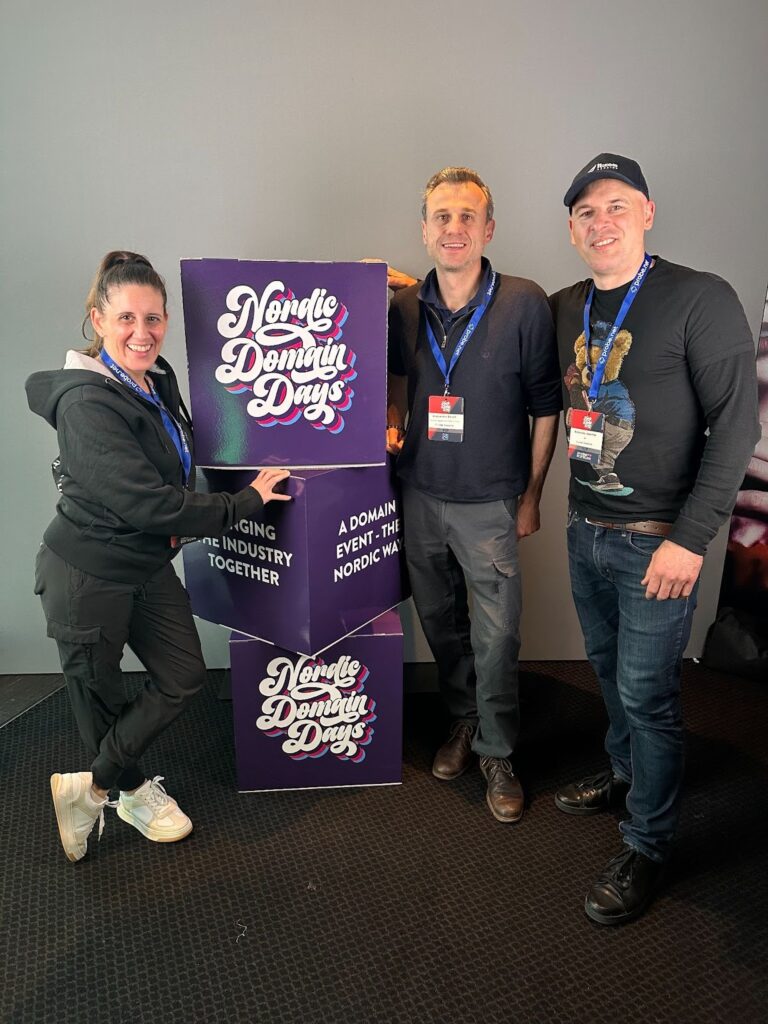
Alessandro with Tess Diaz and Rolandas Japertas
it.com Domains: Italy has always been renowned for its offline brands, but now it’s on par with other countries in terms of online development. What has changed?
AB: They were forced to adapt. I feel like the pandemic was a powerful push: companies that had never considered online were forced to rethink their approach. It wasn’t an easy process. In the old world of bricks and mortar, brands were easier to defend, steeped in history and culture, as they were in Italy, where craftsmanship was at its best. This is true of all traditional brands, many of which are now owned by foreign corporations, but they still live on in the virtual world as true Italians.
In recent years, a shift in perception has occurred: even companies that relied on offline sales for decades have realized that they cannot remain competitive without a digital presence. This has affected everyone, from family-run artisan businesses to major fashion houses. They have begun actively investing in online channels, e-commerce, and digital branding, opening new points of contact with customers around the world.
The Internet has given Italian brands the opportunity to communicate their values and aesthetics directly, without intermediaries. Now, a brand stands not only for craftsmanship but also for the ability to speak to a global audience in its own language. And in this context, the domain name — how a company is represented online, how it builds its digital identity, and what message it conveys to the world through its online address — is becoming increasingly important.
it.com Domains: Italian businesses use different domains for different goals — for example, .it for local trust, .ai for innovation, .com for going global. Where does it.com come in, and what role can it play for Italian companies today?
AB: Our .it.com extension perfectly combines the .com and .it suffixes and also conveys a sense of innovative technology. This is a major advantage for our Italian audience. In our experience, Italian companies respond particularly warmly to this; it’s important for them to maintain ties to their home market even as they expand internationally.
Of course, there are over a thousand other TLDs (top-level domains) and some new ones are upcoming, but none of them contain ‘it’ for Italy and IT, and ‘com’ for global recognition. It’s a no-brainer.
it.com Domains: How do it.com Domains help Italian companies enter the global market?
AB: It precisely conveys the distinctive nature of being Italian, or being strongly associated with Italy, coupled with the .com extension. I believe that the .it.com extension makes brands more accessible to an international audience without cutting off their Italian identity. For Italian brands and startups, it’s crucial that a domain name allows them to be ‘from Italy’, while remaining familiar and recognizable in a global environment. In this sense, the .it.com suffix offers them new flexibility. It helps businesses feel confident in international markets — from e-commerce and SaaS (Software as a Service) to the creative industries, where trust and recognition play an important role. But for such solutions to truly take hold in the market, a strong ecosystem of partners is essential. They can convey the domain’s value to end users and help companies make the right choice.
Furthermore, our company actively supports Italian startups and entrepreneurs. For example, last year, together with WMF – We Make Future, Hosting Solutions, and Flazio, we participated in an initiative aimed at developing female entrepreneurship in Italy, helping founders enter international markets with the right digital strategy and domain infrastructure.
it.com Domains: Who does it.com Domains partner with in Italy? Are there any local partners or registrars? What are the unique features of partnerships in Italy?
AB: We have several accredited registrar partners in Italy, some of whom are prominent players in the web hosting market (i.e. HostingSolutions, Nomeasy, Flazio and HostCare). In our experience, local partners play a key role. Italian clients highly value a personal approach and trust.
Domains is a truly international market, but our goal is to bring all the top Italian providers on board. Right now, we are working on technical integration, which is laying the foundation for the launch of the .it.com extension in Italy. This will pave the way for promotion and growth.
it.com Domains: How do you see the domain industry developing in Italy in the coming years?
AB: Provided the domains industry is growing as a whole, it’s likely that Italy will outpace this growth, given that market penetration is less than in more mature European markets where per-capita domains are higher, for example, in Germany, the UK, and the Netherlands. I am confident of this because the country is just beginning to unlock its digitalization potential.
I anticipate that there will be an increase in the creation of microbusinesses, with people starting their own ventures, who will need a domain and website.
The digitalization trend is also gaining momentum in Italy and will benefit the domain market.
it.com Domains: What advice would you give to Italian entrepreneurs building an international brand?
AB: I’d say that you should take full advantage of being Italian when building your international brand. Our country still has a huge value and recognition around the world. You will become aware of this especially if you’re living abroad, which is a stark contrast to what Italians were told until recently at home. For decades, Italian politicians, journalists, and opinion leaders of all kinds told us that we weren’t good enough and they almost succeeded in instilling a sense of shame and inferiority.
Italians were told to look for inspiration and examples abroad, anywhere but in Italy. I say, always turn to the uniqueness of your roots, identity and history, and your Italian brand will flourish on the international stage.
Keen to learn from the leading industry experts? Visit it.com Domains blog and follow us on social media.
Continue reading at the it.com Domains blog...
We spoke with Alessandro Baruffi, Director of International Partnerships at it.com Domains, about the development of the Italian domain market, what makes companies from the Peninsula stand out, and the role of domains and domain extensions in the international success of Italian tech brands.
Italian IT Industry: The Path to the Global Market
it.com Domains: Alessandro, you work with various countries, but Italy is your home market. What’s your take on its business development?
Alessandro Baruffi: My background experience spans many countries and continents. I still cover markets globally, but I also have a special focus on Italy. The IT market in Italy is poised for significant growth over the next few years due to the rising demand for services in tech. I think it’s important to note not just the growth itself, but also that it has become sustainable for the first time; the digital services market in Italy has exceeded €80 billion, and we see companies increasingly investing in cloud, AI, and cybersecurity.
In Italy, business has long relied on offline — factors such as reputation, connections, and personal presence. However, much has changed in recent years. Young entrepreneurs have emerged who think globally and build a digital identity from the ground up.
The country is seeing incentives for innovation and digital disruption including tax credits for Research & Experimentation (Credito d’Imposta Ricerca & Sviluppo), funding programs such as Smart & Start Italia for innovative startups, and initiatives under the National Recovery and Resilience Plan (NRRP) that support digital transformation and technological adoption. I think these programs have been crucial for many startups that previously simply couldn’t afford to scale their technologies.
Italian companies are increasingly recognizing the need for an online presence, digital services, and flexible models. Government support is also accelerating this trend: through NRRP and related programs, the state provides direct funding, grants, and tax incentives for digitalization projects, IT infrastructure upgrades, adoption of cloud and AI solutions, and workforce digital skills development, making it easier for companies to modernize and scale. This removes some of the barriers that have long hindered the growth of the digital economy in Italy.
All of this offers Italy the opportunity to move from an economy focused on traditional industries to an ecosystem where domain names, digital platforms, and online brand identity are becoming an important part of the growth strategy.
it.com Domains: How do you assess the development of the Italian tech sector?
AB: According to my observations, businesses—both large and small—are for the first time massively transitioning to digital processes. All indicators show great opportunities ahead with sustained growth and a steady increase in market volume, as the country catches up where it was previously lagging behind: from digitization and the transformation of processes to data protection and cybersecurity, and cloud infrastructure and services.
Demand for IT services in Italy is currently growing rapidly. This is driven by several factors.
We see three key factors: companies are actively migrating to the cloud (about 55% ones have already done so), 5G network has finally become widespread, and government digitalization projects are working in practice—not just on paper.This is fueling both the growth of IT technologies and the market itself. The Italian IT market will reach €126 billion by 2030.
Therefore, it’s safe to say that the IT market in Italy will grow significantly in the next few years, as the demand for the services on offer increases. And this is something that was almost non-existent in Italy before.
it.com Domains: What distinguishes Italian entrepreneurs and tech companies from their counterparts in other European countries?
AB: In Italy, the startup scene has taken a while to develop, so we’re now at a point where things are happening in just a handful of vibrant IT innovation hubs. In my opinion, this is a normal stage of development and it has finally begun. Milan has become the country’s main center for innovation, accounting for almost half of the national startup ecosystem value, while Turin, Rome, and Bologna are emerging as strong clusters in fintech, mobility, and AI.
There is a strong pool of skilled computer scientists and engineers from a few prestigious universities. We see this ourselves all the time when we work with local teams, that the level is really high. It’s crucial to keep these young innovators here, in Italy, because the dynamism comes from them.
Despite challenges, new IT businesses are growing, thanks to increased access to venture capital (VC) and other funding opportunities. The volume of investment is growing, but still lags behind France and Germany. And I believe this is where enormous potential lies: underinvested markets typically grow the fastest.
In any case, many major international tech giants have a long-standing presence in the country and have helped to develop a virtuous, ever-growing ecosystem around them.
Italian entrepreneurs are known for their creativity and ability to adapt to any situation. They are tough and used to sailing rough seas, they have what it takes in their DNA to overcome any obstacle.
We can even see this hardening in their approach to choosing domains. For them, a domain name isn’t just an address to be grabbed ‘because it’s available,’ but an asset that will stand the test of time, business transformation, and expansion beyond Italy.
The Italian Domain Market: From Tradition to Digital Growth

Alessandro with Tess Diaz and Rolandas Japertas
it.com Domains: Italy has always been renowned for its offline brands, but now it’s on par with other countries in terms of online development. What has changed?
AB: They were forced to adapt. I feel like the pandemic was a powerful push: companies that had never considered online were forced to rethink their approach. It wasn’t an easy process. In the old world of bricks and mortar, brands were easier to defend, steeped in history and culture, as they were in Italy, where craftsmanship was at its best. This is true of all traditional brands, many of which are now owned by foreign corporations, but they still live on in the virtual world as true Italians.
In recent years, a shift in perception has occurred: even companies that relied on offline sales for decades have realized that they cannot remain competitive without a digital presence. This has affected everyone, from family-run artisan businesses to major fashion houses. They have begun actively investing in online channels, e-commerce, and digital branding, opening new points of contact with customers around the world.
The Internet has given Italian brands the opportunity to communicate their values and aesthetics directly, without intermediaries. Now, a brand stands not only for craftsmanship but also for the ability to speak to a global audience in its own language. And in this context, the domain name — how a company is represented online, how it builds its digital identity, and what message it conveys to the world through its online address — is becoming increasingly important.
it.com Domains: Italian businesses use different domains for different goals — for example, .it for local trust, .ai for innovation, .com for going global. Where does it.com come in, and what role can it play for Italian companies today?
AB: Our .it.com extension perfectly combines the .com and .it suffixes and also conveys a sense of innovative technology. This is a major advantage for our Italian audience. In our experience, Italian companies respond particularly warmly to this; it’s important for them to maintain ties to their home market even as they expand internationally.
Of course, there are over a thousand other TLDs (top-level domains) and some new ones are upcoming, but none of them contain ‘it’ for Italy and IT, and ‘com’ for global recognition. It’s a no-brainer.
it.com Domains: How do it.com Domains help Italian companies enter the global market?
AB: It precisely conveys the distinctive nature of being Italian, or being strongly associated with Italy, coupled with the .com extension. I believe that the .it.com extension makes brands more accessible to an international audience without cutting off their Italian identity. For Italian brands and startups, it’s crucial that a domain name allows them to be ‘from Italy’, while remaining familiar and recognizable in a global environment. In this sense, the .it.com suffix offers them new flexibility. It helps businesses feel confident in international markets — from e-commerce and SaaS (Software as a Service) to the creative industries, where trust and recognition play an important role. But for such solutions to truly take hold in the market, a strong ecosystem of partners is essential. They can convey the domain’s value to end users and help companies make the right choice.
Furthermore, our company actively supports Italian startups and entrepreneurs. For example, last year, together with WMF – We Make Future, Hosting Solutions, and Flazio, we participated in an initiative aimed at developing female entrepreneurship in Italy, helping founders enter international markets with the right digital strategy and domain infrastructure.
Partners and the Ecosystem: How the Domain Business is Built in Italy
it.com Domains: Who does it.com Domains partner with in Italy? Are there any local partners or registrars? What are the unique features of partnerships in Italy?
AB: We have several accredited registrar partners in Italy, some of whom are prominent players in the web hosting market (i.e. HostingSolutions, Nomeasy, Flazio and HostCare). In our experience, local partners play a key role. Italian clients highly value a personal approach and trust.
Domains is a truly international market, but our goal is to bring all the top Italian providers on board. Right now, we are working on technical integration, which is laying the foundation for the launch of the .it.com extension in Italy. This will pave the way for promotion and growth.
Looking Ahead: Italy’s Digital Future
it.com Domains: How do you see the domain industry developing in Italy in the coming years?
AB: Provided the domains industry is growing as a whole, it’s likely that Italy will outpace this growth, given that market penetration is less than in more mature European markets where per-capita domains are higher, for example, in Germany, the UK, and the Netherlands. I am confident of this because the country is just beginning to unlock its digitalization potential.
I anticipate that there will be an increase in the creation of microbusinesses, with people starting their own ventures, who will need a domain and website.
The digitalization trend is also gaining momentum in Italy and will benefit the domain market.
it.com Domains: What advice would you give to Italian entrepreneurs building an international brand?
AB: I’d say that you should take full advantage of being Italian when building your international brand. Our country still has a huge value and recognition around the world. You will become aware of this especially if you’re living abroad, which is a stark contrast to what Italians were told until recently at home. For decades, Italian politicians, journalists, and opinion leaders of all kinds told us that we weren’t good enough and they almost succeeded in instilling a sense of shame and inferiority.
Italians were told to look for inspiration and examples abroad, anywhere but in Italy. I say, always turn to the uniqueness of your roots, identity and history, and your Italian brand will flourish on the international stage.
Keen to learn from the leading industry experts? Visit it.com Domains blog and follow us on social media.
Continue reading at the it.com Domains blog...

