




- Joined
- Oct 12, 2023
- Posts
- 254
- Reaction score
- 69
A domain name can cost relatively little to register, yet it may sit underneath a company’s website, email, advertising, and online brand. That makes the question of domain ownership more important than it first appears - and somewhat sensitive.
Problems often surface years after registration, when a business discovers that a former employee, freelancer, agency, or hosting provider controls the domain ownership.
That concern appears regularly among web professionals. One question on Reddit asked whether third-party agents like agencies, freelancers or contractors should buy and manage domains or let clients hold their own accounts. Many replies favored client ownership with delegated access for the developer. A similar pattern appears in another Reddit discussion, where developers discussed the risk of renewals and ownership becoming tied to the supplier rather than the client.
Learn who practically can be listed as the domain owner, what information goes into the registrar account, how third parties can receive access, and what a good website handover looks like.
Buying a domain is different from buying a physical asset outright. A domain is registered for a pre-defined period and can normally be renewed as long as the registration rules and fees are met.
For domains covered by ICANN rules, ICANN defines a registrant as the individual or entity that registers the domain and enters into an agreement with the registrar. That registrant, sometimes called the registered name holder, receives the rights and responsibilities linked to the registration.
This distinction matters at scale. According to Verisign, there were 401.6 million domain name registrations across all top-level domains at the end of Q2 2026. Many of them support active businesses, so knowing who controls each registration is a fundamental part of digital administration.
For a business using a name such as brightstudio.it.com, the cleanest ownership structure is usually one where the business itself appears as the registrant or registered customer, rather than an outside supplier. This reduces reliance on one designer, developer, or employee staying available forever.
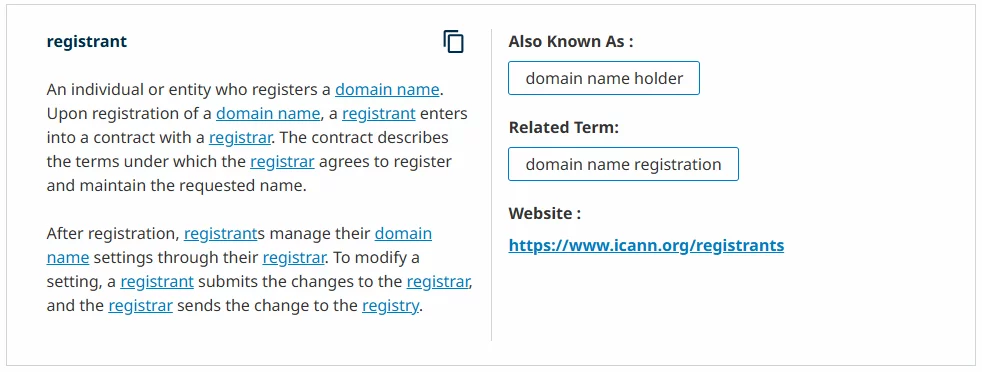
Source: ICANN
Domain ownership is easier to manage when the commercial owner and the people providing technical support have clearly different roles.
The registrant details identify the person or organization connected with the registration.
For a company domain, listing the legal business entity generally creates less uncertainty than using the personal details of an employee, freelancer, or agency owner.
Paying the invoice does not necessarily prove domain ownership. A company could pay every renewal bill while the registration remains under someone else’s name.
This is one of several common domain buying mistakes that may not become obvious until a transfer or handover is needed.
The account email often receives password resets, renewal notices, security alerts, and transfer confirmations.
A personal employee address creates an obvious weak point if that person leaves. An agency address creates the same issue if the supplier relationship ends.
A role-based business address can provide more continuity. Some businesses also keep a separate recovery address that does not depend entirely on the domain being managed. That can matter if an expired domain causes the company’s normal email to stop working.
Contact information also needs to remain current. ICANN’s registration data policy requires registrars to collect registrant contact information for covered gTLD registrations, although much of that information may be hidden from public view.
Website development agencies often need to change DNS records, connect hosting, verify email services, or support a website migration. None of those tasks automatically require the agency to become the registrant.
Many registrars and DNS platforms support delegated users or separate administrator accounts. In that model, the business keeps the main registrar account while the agency receives the permissions needed for its work. This separates ownership from management.
The difference becomes useful when a supplier changes. Removing delegated access is usually much simpler than trying to recover a domain that sits inside somebody else’s account.
Domain credentials can unlock one of the company’s most important digital assets.
A company password manager or another controlled credential vault can hold registrar logins, two-factor authentication recovery codes, and details of who has access. Shared spreadsheets, old emails, or messages to a developer are much harder to manage when staff change.
Where individual user accounts are available, they also reduce the need for several people to share one master password.
Account security plays a role in how not to lose your domain name, alongside renewal management and registrar locks.

Source: Unsplash
A finished website project involves more than handing over the CMS password.
A useful handover record can include:
A transfer code itself does not need to sit permanently in an everyday document. Access to it is sensitive, and many registrars generate it when required.
The same inventory can support wider efforts to protect your brand as the business adds products, markets, or additional domain names.
When an employee, freelancer, or agency leaves, the domain can form part of the same access review as email, hosting, analytics, and cloud software.
That review may include removing delegated accounts, replacing shared credentials, checking recovery details, and confirming that billing information still belongs to the business.
The situation becomes more complicated if the departing person is the registered domain holder. In that case, the registration details may need to change before the business has full independent control.
A domain transfer can describe two related processes: moving a domain to another registrar or changing the person or organization recorded as the holder.

Source: Pexels
A typical handover looks like this:
The website itself does not necessarily move during a domain transfer. If the DNS records stay unchanged, the same website and email services can continue pointing to their existing servers.
WHOIS and newer Registration Data Directory Services can reveal information such as the registrar, domain status, and registration dates. However, public records no longer guarantee that the registrant’s personal details will appear.
Privacy services and data protection rules may redact the name, email address, phone number, or street address. ICANN explains that privacy and proxy services can replace public contact information while still allowing communication through another channel.
So, if the question is “who owns my domain name?”, a public lookup may only be the first step. Registrar account access, contracts, invoices, internal records, and communication with the registrar can provide more context.
Domain ownership works best when the registration, account access, and supplier relationship are treated as separate things. A designer or developer may manage the technical setup while the business keeps control of the registration itself. A clear account structure, secure recovery process, and documented handover can make future staff changes or a domain transfer much easier to manage.
Not in the same way as a physical asset. Registering a domain normally gives the registrant the right to use and control it for a fixed registration period, subject to the registrar or registry agreement. The registration can usually be renewed, transferred, or allowed to expire.
The person or organization recorded as the registrant or registered name holder normally holds the registration rights under the relevant agreement. The registrar manages the registration service, while a web agency, hosting company, or developer may manage technical settings without being the domain owner.
Sometimes. WHOIS or other registration lookup services may show public registrant information, but privacy protection or data protection rules often hide personal details. A lookup can still reveal the registrar and other registration information that helps identify the next point of contact.
Verification can involve checking the registrar account, confirming the registrant details held by the provider, and reviewing contracts or registration records. Online services may also verify domain control through DNS records, email, or a file added to the website, although proving technical control is not always the same as proving contractual registration rights.
If another person or company currently holds the registration, the usual route is an agreed transfer or change of registrant through the registrar. The current holder may need to approve the request and provide an authorization code. If ownership is disputed rather than voluntarily transferred, the available process depends on the domain, registrar, registry rules, contracts, and any applicable dispute procedure.
Looking for some practical tips to manage your domains? Visit it.com Domains’ blog and contact us on social media.
Continue reading at the it.com Domains blog...
Problems often surface years after registration, when a business discovers that a former employee, freelancer, agency, or hosting provider controls the domain ownership.
That concern appears regularly among web professionals. One question on Reddit asked whether third-party agents like agencies, freelancers or contractors should buy and manage domains or let clients hold their own accounts. Many replies favored client ownership with delegated access for the developer. A similar pattern appears in another Reddit discussion, where developers discussed the risk of renewals and ownership becoming tied to the supplier rather than the client.
Learn who practically can be listed as the domain owner, what information goes into the registrar account, how third parties can receive access, and what a good website handover looks like.
What Does Domain Ownership Actually Mean?
Buying a domain is different from buying a physical asset outright. A domain is registered for a pre-defined period and can normally be renewed as long as the registration rules and fees are met.
For domains covered by ICANN rules, ICANN defines a registrant as the individual or entity that registers the domain and enters into an agreement with the registrar. That registrant, sometimes called the registered name holder, receives the rights and responsibilities linked to the registration.
This distinction matters at scale. According to Verisign, there were 401.6 million domain name registrations across all top-level domains at the end of Q2 2026. Many of them support active businesses, so knowing who controls each registration is a fundamental part of digital administration.
For a business using a name such as brightstudio.it.com, the cleanest ownership structure is usually one where the business itself appears as the registrant or registered customer, rather than an outside supplier. This reduces reliance on one designer, developer, or employee staying available forever.
Source: ICANN
Domain Ownership Checklist for Businesses
Domain ownership is easier to manage when the commercial owner and the people providing technical support have clearly different roles.
1. Check who is listed as the registrant
The registrant details identify the person or organization connected with the registration.
For a company domain, listing the legal business entity generally creates less uncertainty than using the personal details of an employee, freelancer, or agency owner.
Paying the invoice does not necessarily prove domain ownership. A company could pay every renewal bill while the registration remains under someone else’s name.
This is one of several common domain buying mistakes that may not become obvious until a transfer or handover is needed.
2. Use an email account the business controls
The account email often receives password resets, renewal notices, security alerts, and transfer confirmations.
A personal employee address creates an obvious weak point if that person leaves. An agency address creates the same issue if the supplier relationship ends.
A role-based business address can provide more continuity. Some businesses also keep a separate recovery address that does not depend entirely on the domain being managed. That can matter if an expired domain causes the company’s normal email to stop working.
Contact information also needs to remain current. ICANN’s registration data policy requires registrars to collect registrant contact information for covered gTLD registrations, although much of that information may be hidden from public view.
3. Give agencies access without transferring ownership
Website development agencies often need to change DNS records, connect hosting, verify email services, or support a website migration. None of those tasks automatically require the agency to become the registrant.
Many registrars and DNS platforms support delegated users or separate administrator accounts. In that model, the business keeps the main registrar account while the agency receives the permissions needed for its work. This separates ownership from management.
The difference becomes useful when a supplier changes. Removing delegated access is usually much simpler than trying to recover a domain that sits inside somebody else’s account.
4. Store passwords and recovery codes as business records
Domain credentials can unlock one of the company’s most important digital assets.
A company password manager or another controlled credential vault can hold registrar logins, two-factor authentication recovery codes, and details of who has access. Shared spreadsheets, old emails, or messages to a developer are much harder to manage when staff change.
Where individual user accounts are available, they also reduce the need for several people to share one master password.
Account security plays a role in how not to lose your domain name, alongside renewal management and registrar locks.
Source: Unsplash
5. Include the domain in the website handover document
A finished website project involves more than handing over the CMS password.
A useful handover record can include:
- the domain name and registrar
- the registered business or registrant
- renewal and expiration information
- who controls the payment method
- nameservers and DNS provider
- hosting and CMS access
- email provider
- delegated users
- analytics and search platform access
- two-factor authentication and recovery process
- instructions for obtaining a transfer or authorization code
A transfer code itself does not need to sit permanently in an everyday document. Access to it is sensitive, and many registrars generate it when required.
The same inventory can support wider efforts to protect your brand as the business adds products, markets, or additional domain names.
6. Review domain access when someone leaves
When an employee, freelancer, or agency leaves, the domain can form part of the same access review as email, hosting, analytics, and cloud software.
That review may include removing delegated accounts, replacing shared credentials, checking recovery details, and confirming that billing information still belongs to the business.
The situation becomes more complicated if the departing person is the registered domain holder. In that case, the registration details may need to change before the business has full independent control.
How a Domain Transfer and Ownership Handover Works
A domain transfer can describe two related processes: moving a domain to another registrar or changing the person or organization recorded as the holder.
Source: Pexels
A typical handover looks like this:
- Identify the current registrar. A registration lookup may show which company manages the domain - here are several ways to find out who owns a domain name.
- Check the account and registrant details. The business can compare its records with the information held by the registrar.
- Request the ownership change or transfer. The existing holder may need to approve the request. Transfers between registrars commonly use an authorization or EPP code. ICANN describes an Auth-Code as a code used to help identify the domain holder and authorize a transfer.
- Check transfer restrictions. Some domains can be locked temporarily after registration, a recent transfer, or a registrant change. Rules vary by extension and provider, so the registrar’s current policy matters.
- Confirm access after completion. Registrar login, renewal settings, billing information, DNS access, recovery methods, and delegated users can all be reviewed once the handover finishes.
The website itself does not necessarily move during a domain transfer. If the DNS records stay unchanged, the same website and email services can continue pointing to their existing servers.
What if WHOIS Does not Show Who Owns my Domain Name?
WHOIS and newer Registration Data Directory Services can reveal information such as the registrar, domain status, and registration dates. However, public records no longer guarantee that the registrant’s personal details will appear.
Privacy services and data protection rules may redact the name, email address, phone number, or street address. ICANN explains that privacy and proxy services can replace public contact information while still allowing communication through another channel.
So, if the question is “who owns my domain name?”, a public lookup may only be the first step. Registrar account access, contracts, invoices, internal records, and communication with the registrar can provide more context.
Domain ownership works best when the registration, account access, and supplier relationship are treated as separate things. A designer or developer may manage the technical setup while the business keeps control of the registration itself. A clear account structure, secure recovery process, and documented handover can make future staff changes or a domain transfer much easier to manage.
FAQs
If I buy a domain name, do I actually own it?
Not in the same way as a physical asset. Registering a domain normally gives the registrant the right to use and control it for a fixed registration period, subject to the registrar or registry agreement. The registration can usually be renewed, transferred, or allowed to expire.
Who actually owns a domain?
The person or organization recorded as the registrant or registered name holder normally holds the registration rights under the relevant agreement. The registrar manages the registration service, while a web agency, hosting company, or developer may manage technical settings without being the domain owner.
Can I find the owner of a domain name?
Sometimes. WHOIS or other registration lookup services may show public registrant information, but privacy protection or data protection rules often hide personal details. A lookup can still reveal the registrar and other registration information that helps identify the next point of contact.
How to verify ownership of a domain name?
Verification can involve checking the registrar account, confirming the registrant details held by the provider, and reviewing contracts or registration records. Online services may also verify domain control through DNS records, email, or a file added to the website, although proving technical control is not always the same as proving contractual registration rights.
How to take ownership of a domain name?
If another person or company currently holds the registration, the usual route is an agreed transfer or change of registrant through the registrar. The current holder may need to approve the request and provide an authorization code. If ownership is disputed rather than voluntarily transferred, the available process depends on the domain, registrar, registry rules, contracts, and any applicable dispute procedure.
Looking for some practical tips to manage your domains? Visit it.com Domains’ blog and contact us on social media.
Continue reading at the it.com Domains blog...

