




- Joined
- Oct 12, 2023
- Posts
- 255
- Reaction score
- 69
A domain name used to be treated like a line on a startup checklist. Pick a name, register it, build the site, move on. That thinking is changing. For founders, investors, and growing businesses, a strong domain can become a brand signal, a scarce digital asset, and in rare cases, a piece of internet history.
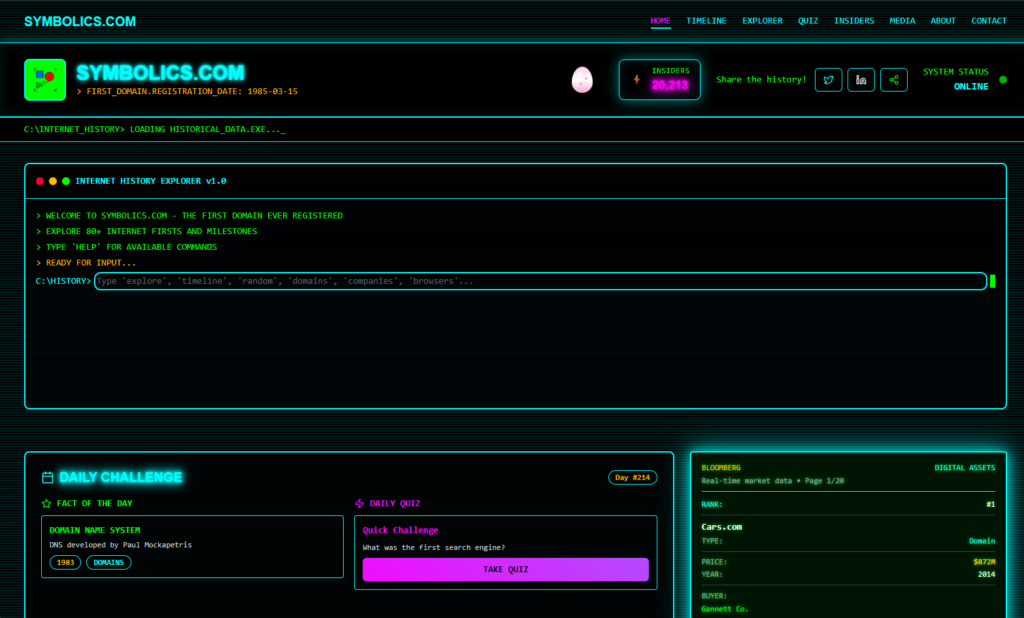
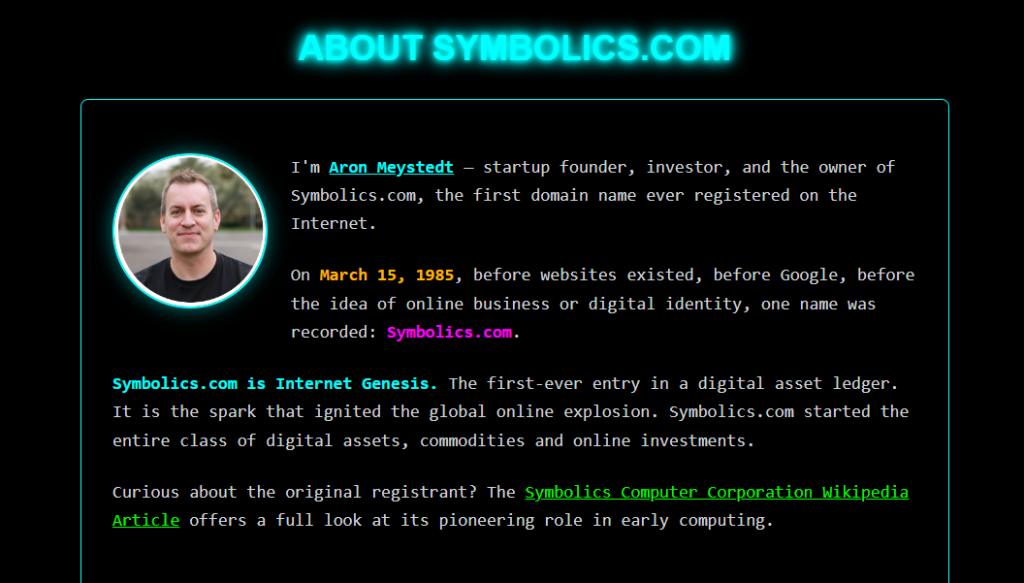
To explore this shift, we spoke with Aron Meystedt, startup founder, investor, and owner of Symbolics.com, widely recognized as the first .com domain ever registered.
Symbolics.com was registered on March 15, 1985, before the web became part of daily business life. Today, the domain is a cultural object and a reminder that every business now starts with a name people can find. Aron sees this reaction in real life.
“Fun story. I live in Orlando now, moved here from Southern California three years ago. A founder friend of mine in Orlando owns a box at the Orlando City Soccer Team’s home stadium. He invited me to watch a game, along with a few other startup founder friends of his.”
As founders started sharing what they were working on, one detail changed the room.
“My friend told the small group: ‘Oh yeah. Aron here owns the very first .com ever registered on the Internet.’”
“That’s literally all the group wanted to talk about for the next 30 minutes. How did I get it? What’s it worth? How is this not in the hands of a major corporation? What other historical firsts could an individual actually own that are as significant?”
Source: Symbolics.com
That moment says a lot about premium domains. Some names carry meaning before a visitor even reaches the homepage.
“People seem to love it. It’s a piece of Internet history and an amazing conversation piece.”
The domain market keeps growing. According to Verisign’s Domain Name Industry Brief, there were 401.6 million domain name registrations across all top-level domains at the end of Q2 2026. When supply feels large, it is easy to assume good names are everywhere. In practice, memorable names remain scarce.
Aron first saw this in the early 2000s. “Every time I hunt for a domain name for a project, everything good is taken. And this was in 2000! I wonder if there’s a way to track down those taken domain names and resell them?”
That question led him into the domain aftermarket. “Once I discovered the domain aftermarket, I wanted to answer my own curiosity: “What would be the ultimate domain name to own”? Of course, I pondered exact match names like Cars.com (as someone that loves cars), Collectibles.com (as someone that loves to collect things) Shoes.com, Houses.com and more.”
“Then I thought a bit outside the box, landing on names that felt more collectible and rare, like two and three letter .com domains. Not long into the thought experiment did I ask, “I wonder what the very first registered domain name was.” So I stumbled upon Symbolics.com and the company of the same name that were incredible pioneers in the computing space. I revisited Symbolics.com 17 years ago, in 2009, and I inquired to the Symbolics Computer Corporation about if they’d ever let the domain name go.”
The timing was in Aron’s favor. “Countless others had asked in the past and been rejected. I happened to catch them on an interesting day when they were restructuring and actually open to selling the name for the first time. The deal was quickly closed. I’m very honored to be the steward of this piece of history.”
Source: Symbolics.com
A premium domain is usually more desirable because it is short, clear, brandable, commercially relevant, historically important, or already trusted by users and search engines.
Aron uses a simpler test. “I always perform this one test: Will I remember this name when I wake up tomorrow?”
For small and medium businesses, that question cuts through a lot of noise. A short domain name such as launch.it.com, studio.it.com, or secure.it.com is easier to say, type, and remember than a long string packed with keywords. Availability and pricing will vary, but the naming principle stays the same.
“If someone gives me a list of 30 names, I pick out the one I think I will remember.”
Aron still sees .com as the default for many founders, but he also points out that memorability can work across extensions when the full name makes sense. “A memorable name can hold any extension as long as it makes sense with the word in front of it.”
“The value is in the name, the raw land itself. You can build what you like on the domain name, but the name will hold value all by itself regardless of if your venture fails or succeeds.”
That is why some founders now think of a domain as an asset for a startup, not just a technical setup task.
That does not mean every domain is valuable. So, what makes a domain premium? It is rarely one thing. Aron lists short acronyms, historical names, exact-match names, traffic-rich names, backlink-rich names, and names with high-intent customers as examples.

Source: Unsplash
The common thread is simple: the name has demand beyond one owner’s private use. Yet, there is always room for experiments.
“For example, I’d love to start a marketplace of just names with notable history or past ownership.
Aron points out that such domains create opportunities for creative campaigns, storytelling, provenance, trust and general PR.
A premium domain can bring direct traffic, but traffic is only one part of the picture.
“Previously mentioned but many people overlook backlinks.”
A domain with a clean backlink profile may still have residual authority from its past life. That can matter if a business plans to rebuild in a similar category. Aron also gives a warning that is easy to overlook.
“Past usage can be good and bad as well. If a name was previously used cleanly, and you want to rebuild it in a similar vertical, you might have an advantage there. If it was used nefariously, then you’ll be starting with the wind in your face.”
That is why domain history matters. A name may look polished on the surface but carry old associations under the hood. Before buying, businesses often review archive history, backlinks, trademark risk, and whether the domain was ever used for spam, malware, or thin affiliate sites.
Trust is another layer. A clean, clear domain name can shape first impressions before the website design, product page, or checkout flow has a chance to do any work. That makes domain choice closely linked to user trust.
Aron says many founders want short, memorable names with room to grow.
“They all want a short memorable word that has no direct commercial meaning. Generic words are best. Blast, Blaze, Quick, Shout, names like that which don't lend to any one specific use, because businesses often pivot and morph along the way and they don’t want to paint themselves into a corner with a descriptive name.”
That point matters for smaller businesses too. A bakery may start with wedding cakes and later expand into classes, catering, subscriptions, or corporate gifting. A name such as bake.it.com may leave more room than bestweddingcakesorlando.it.com. One tells a story with space to grow. The other explains today’s service in tiny print.
A premium domain can also affect how a company is perceived.
“Customers and partners assume a company is here to stay when they see a short name like this. It’s not everything in strategy, but it’s a valuable piece for sure.”
That does not make the domain a magic wand. A strong name cannot fix a weak product, slow service, or unclear offer. It can, however, reduce friction. In crowded markets, less friction is not glamorous, but it is useful.

Source: Pexels
Buying a domain too late can create a pricing problem. If a company gains funding, press, public traction, the owner of the ideal domain may spot the perfect buyer.
Aron recently discussed this with a founder closing a pre-seed $5M round.
“They want a one word .com name and will spend into the 6 figures for it. But, there is a delicate path forward where they don’t show their cards by announcing their name and funding round. It’s smart to start looking at exactly what name you want to buy now, and once funding is completed, lock it up before announcing your plans.”
For early-stage companies, the timing question depends on budget, ambition, and risk. Some businesses start with a practical domain and upgrade later. Others may secure the strongest available name before launch because the future cost of switching could be higher.
Aron keeps the point balanced. “If you’re a solopreneur, go ahead and launch on whatever domain name you can afford. There’s no reason to break the bank. Later, if you are wildly successful with your venture, you can worry about a top domain name later.”
A growing company may also consider a second domain for a campaign, new product, local market, or brand protection. That can be a lighter route than changing the main brand name.
Investing in premium domains is different from buying shares, crypto, or collectibles. The asset can be scarce, but liquidity is not guaranteed.
“This is very important to me, because I think all wealthy investors should have a small domain name portfolio. But, for some reason, that messaging isn’t resonating.”
Aron sees a few reasons. Domain names do not usually create predictable revenue. They cannot always be sold quickly. Every domain is one of one, so price comparisons can be messy.
“For us domain investors, they should be seen as long term investments that might take years to sell for fair market value.”
Public sales still show why the market attracts attention. Recent domain sales trends show growing interest in category-defining names, while historically one reported sale price reached $70m. It is no surprise that some CEOs should pay attention when domain names become tied to category leadership.
Still, Aron is careful about speculative buying. “Do not go out and register 500 random names. Start with one aftermarket name and see how it goes.”

Source: Unsplash
AI is changing how people discover companies. Instead of typing one query and scanning ten blue links, users may ask ChatGPT, Perplexity, Gemini, or another AI assistant to compare providers and summarize options.
Will that make domain names more or less important?
“More,” he says. “In the eyes of humans. Neutral in the eyes of the AI agents that recommend products and services.”
Aron’s view is that AI agents are not judging domain quality in the same way people do. They look for consistency, citations, reliable information - but the human layer still matters.
“A good domain could help your company receive more citations due to the perceived legitimacy by humans, which will impact the AI recommendations.”
In other words, a premium domain may not directly “rank” a business inside AI but it can support the wider signals that AI tools are likely to find. “Aged premium names could become trusted by AI agents themselves, as there could be a flood of new junk registration domain names to game AI systems – and AI agents could possibly default to age, trust and provenance to signal legitimacy.“
Looking further ahead, Aron sees domains as infrastructure. “Your domain will be the parcel of land your company sits on, and AI agents will visit it and pull the necessary products and information for curious users.”

Source: Unsplash
A business comparing premium domain options can ask:
These prompts help making the decision less emotional and more structured, which is helpful when a name looks exciting and the invoice looks very real.
Premium domains are becoming digital assets because the best names can carry trust, memory, scarcity, history, and strategic value. Aron Meystedt’s experience with Symbolics.com shows the extreme end of that story, but the same principles can help smaller businesses think more clearly about naming. For companies that depend on credibility, easy discovery, and long-term brand building, the right name can become part of the foundation rather than just the address on the front door.
Yes. A domain can be considered a digital asset because it is an online property that a person or business can own, use, transfer, and sometimes resell. Its value depends on factors such as demand, memorability, history, backlinks, trust, and how useful it is to a buyer.
A premium domain is a domain name that has higher perceived value than a standard available name. It may be short, easy to spell, brandable, keyword-rich, historically important, linked to a strong category, or supported by existing traffic and backlinks.
It depends on the business goal, budget, and growth plans. A premium domain may be worth considering when the name supports trust, brand recall, investor perception, or long-term positioning. For very early or budget-limited projects, a standard domain can still be a practical starting point.
Continue reading at the it.com Domains blog...
To explore this shift, we spoke with Aron Meystedt, startup founder, investor, and owner of Symbolics.com, widely recognized as the first .com domain ever registered.
The Human Story behind the First .com
Symbolics.com was registered on March 15, 1985, before the web became part of daily business life. Today, the domain is a cultural object and a reminder that every business now starts with a name people can find. Aron sees this reaction in real life.
“Fun story. I live in Orlando now, moved here from Southern California three years ago. A founder friend of mine in Orlando owns a box at the Orlando City Soccer Team’s home stadium. He invited me to watch a game, along with a few other startup founder friends of his.”
As founders started sharing what they were working on, one detail changed the room.
“My friend told the small group: ‘Oh yeah. Aron here owns the very first .com ever registered on the Internet.’”
“That’s literally all the group wanted to talk about for the next 30 minutes. How did I get it? What’s it worth? How is this not in the hands of a major corporation? What other historical firsts could an individual actually own that are as significant?”
Source: Symbolics.com
That moment says a lot about premium domains. Some names carry meaning before a visitor even reaches the homepage.
“People seem to love it. It’s a piece of Internet history and an amazing conversation piece.”
From Web Address to Digital Asset
The domain market keeps growing. According to Verisign’s Domain Name Industry Brief, there were 401.6 million domain name registrations across all top-level domains at the end of Q2 2026. When supply feels large, it is easy to assume good names are everywhere. In practice, memorable names remain scarce.
Aron first saw this in the early 2000s. “Every time I hunt for a domain name for a project, everything good is taken. And this was in 2000! I wonder if there’s a way to track down those taken domain names and resell them?”
That question led him into the domain aftermarket. “Once I discovered the domain aftermarket, I wanted to answer my own curiosity: “What would be the ultimate domain name to own”? Of course, I pondered exact match names like Cars.com (as someone that loves cars), Collectibles.com (as someone that loves to collect things) Shoes.com, Houses.com and more.”
“Then I thought a bit outside the box, landing on names that felt more collectible and rare, like two and three letter .com domains. Not long into the thought experiment did I ask, “I wonder what the very first registered domain name was.” So I stumbled upon Symbolics.com and the company of the same name that were incredible pioneers in the computing space. I revisited Symbolics.com 17 years ago, in 2009, and I inquired to the Symbolics Computer Corporation about if they’d ever let the domain name go.”
The timing was in Aron’s favor. “Countless others had asked in the past and been rejected. I happened to catch them on an interesting day when they were restructuring and actually open to selling the name for the first time. The deal was quickly closed. I’m very honored to be the steward of this piece of history.”
Source: Symbolics.com
What Makes a Domain Premium?
A premium domain is usually more desirable because it is short, clear, brandable, commercially relevant, historically important, or already trusted by users and search engines.
Aron uses a simpler test. “I always perform this one test: Will I remember this name when I wake up tomorrow?”
For small and medium businesses, that question cuts through a lot of noise. A short domain name such as launch.it.com, studio.it.com, or secure.it.com is easier to say, type, and remember than a long string packed with keywords. Availability and pricing will vary, but the naming principle stays the same.
“If someone gives me a list of 30 names, I pick out the one I think I will remember.”
Aron still sees .com as the default for many founders, but he also points out that memorability can work across extensions when the full name makes sense. “A memorable name can hold any extension as long as it makes sense with the word in front of it.”
“The value is in the name, the raw land itself. You can build what you like on the domain name, but the name will hold value all by itself regardless of if your venture fails or succeeds.”
That is why some founders now think of a domain as an asset for a startup, not just a technical setup task.
That does not mean every domain is valuable. So, what makes a domain premium? It is rarely one thing. Aron lists short acronyms, historical names, exact-match names, traffic-rich names, backlink-rich names, and names with high-intent customers as examples.
Source: Unsplash
The common thread is simple: the name has demand beyond one owner’s private use. Yet, there is always room for experiments.
“For example, I’d love to start a marketplace of just names with notable history or past ownership.
- A defunct company with tons of backlinks and an instantly recognizable brand name. Example: Enron.com was purchased a few years ago and again has a large following as this name was given a new life.
- Names owned by past founders, celebrities, billionaires. An example would be a name previously owned by Elon Musk or Mark Cuban.”
Aron points out that such domains create opportunities for creative campaigns, storytelling, provenance, trust and general PR.
Value beyond Traffic and SEO
A premium domain can bring direct traffic, but traffic is only one part of the picture.
“Previously mentioned but many people overlook backlinks.”
A domain with a clean backlink profile may still have residual authority from its past life. That can matter if a business plans to rebuild in a similar category. Aron also gives a warning that is easy to overlook.
“Past usage can be good and bad as well. If a name was previously used cleanly, and you want to rebuild it in a similar vertical, you might have an advantage there. If it was used nefariously, then you’ll be starting with the wind in your face.”
That is why domain history matters. A name may look polished on the surface but carry old associations under the hood. Before buying, businesses often review archive history, backlinks, trademark risk, and whether the domain was ever used for spam, malware, or thin affiliate sites.
Trust is another layer. A clean, clear domain name can shape first impressions before the website design, product page, or checkout flow has a chance to do any work. That makes domain choice closely linked to user trust.
Why Founders Care about Short Names
Aron says many founders want short, memorable names with room to grow.
“They all want a short memorable word that has no direct commercial meaning. Generic words are best. Blast, Blaze, Quick, Shout, names like that which don't lend to any one specific use, because businesses often pivot and morph along the way and they don’t want to paint themselves into a corner with a descriptive name.”
That point matters for smaller businesses too. A bakery may start with wedding cakes and later expand into classes, catering, subscriptions, or corporate gifting. A name such as bake.it.com may leave more room than bestweddingcakesorlando.it.com. One tells a story with space to grow. The other explains today’s service in tiny print.
A premium domain can also affect how a company is perceived.
“Customers and partners assume a company is here to stay when they see a short name like this. It’s not everything in strategy, but it’s a valuable piece for sure.”
That does not make the domain a magic wand. A strong name cannot fix a weak product, slow service, or unclear offer. It can, however, reduce friction. In crowded markets, less friction is not glamorous, but it is useful.
Source: Pexels
The Timing Question
Buying a domain too late can create a pricing problem. If a company gains funding, press, public traction, the owner of the ideal domain may spot the perfect buyer.
Aron recently discussed this with a founder closing a pre-seed $5M round.
“They want a one word .com name and will spend into the 6 figures for it. But, there is a delicate path forward where they don’t show their cards by announcing their name and funding round. It’s smart to start looking at exactly what name you want to buy now, and once funding is completed, lock it up before announcing your plans.”
For early-stage companies, the timing question depends on budget, ambition, and risk. Some businesses start with a practical domain and upgrade later. Others may secure the strongest available name before launch because the future cost of switching could be higher.
Aron keeps the point balanced. “If you’re a solopreneur, go ahead and launch on whatever domain name you can afford. There’s no reason to break the bank. Later, if you are wildly successful with your venture, you can worry about a top domain name later.”
A growing company may also consider a second domain for a campaign, new product, local market, or brand protection. That can be a lighter route than changing the main brand name.
Buying Premium Domains
Investing in premium domains is different from buying shares, crypto, or collectibles. The asset can be scarce, but liquidity is not guaranteed.
“This is very important to me, because I think all wealthy investors should have a small domain name portfolio. But, for some reason, that messaging isn’t resonating.”
Aron sees a few reasons. Domain names do not usually create predictable revenue. They cannot always be sold quickly. Every domain is one of one, so price comparisons can be messy.
“For us domain investors, they should be seen as long term investments that might take years to sell for fair market value.”
Public sales still show why the market attracts attention. Recent domain sales trends show growing interest in category-defining names, while historically one reported sale price reached $70m. It is no surprise that some CEOs should pay attention when domain names become tied to category leadership.
Still, Aron is careful about speculative buying. “Do not go out and register 500 random names. Start with one aftermarket name and see how it goes.”
Source: Unsplash
AI Discovery May Make Trust Signals Matter More
AI is changing how people discover companies. Instead of typing one query and scanning ten blue links, users may ask ChatGPT, Perplexity, Gemini, or another AI assistant to compare providers and summarize options.
Will that make domain names more or less important?
“More,” he says. “In the eyes of humans. Neutral in the eyes of the AI agents that recommend products and services.”
Aron’s view is that AI agents are not judging domain quality in the same way people do. They look for consistency, citations, reliable information - but the human layer still matters.
“A good domain could help your company receive more citations due to the perceived legitimacy by humans, which will impact the AI recommendations.”
In other words, a premium domain may not directly “rank” a business inside AI but it can support the wider signals that AI tools are likely to find. “Aged premium names could become trusted by AI agents themselves, as there could be a flood of new junk registration domain names to game AI systems – and AI agents could possibly default to age, trust and provenance to signal legitimacy.“
Looking further ahead, Aron sees domains as infrastructure. “Your domain will be the parcel of land your company sits on, and AI agents will visit it and pull the necessary products and information for curious users.”
Source: Unsplash
Practical Prompts for Evaluating a Premium Domain
A business comparing premium domain options can ask:
- Will people remember this name tomorrow?
- Can they spell it after hearing it once?
- Does the name leave room for the business to grow?
- Does the extension fit the word or phrase?
- Has the domain been used cleanly before?
- Does the backlink profile support the intended use?
- Could the same name work across email, ads, social media, and sales calls?
- Does the price still leave room for product, marketing, service, and operations?
These prompts help making the decision less emotional and more structured, which is helpful when a name looks exciting and the invoice looks very real.
Premium domains are becoming digital assets because the best names can carry trust, memory, scarcity, history, and strategic value. Aron Meystedt’s experience with Symbolics.com shows the extreme end of that story, but the same principles can help smaller businesses think more clearly about naming. For companies that depend on credibility, easy discovery, and long-term brand building, the right name can become part of the foundation rather than just the address on the front door.
FAQs
Are domains digital assets?
Yes. A domain can be considered a digital asset because it is an online property that a person or business can own, use, transfer, and sometimes resell. Its value depends on factors such as demand, memorability, history, backlinks, trust, and how useful it is to a buyer.
What is a premium domain?
A premium domain is a domain name that has higher perceived value than a standard available name. It may be short, easy to spell, brandable, keyword-rich, historically important, linked to a strong category, or supported by existing traffic and backlinks.
Is it worth buying a premium domain?
It depends on the business goal, budget, and growth plans. A premium domain may be worth considering when the name supports trust, brand recall, investor perception, or long-term positioning. For very early or budget-limited projects, a standard domain can still be a practical starting point.
Continue reading at the it.com Domains blog...



