




- Joined
- Oct 12, 2023
- Posts
- 255
- Reaction score
- 69
Search engines and AI tools can read websites, but they still need help understanding what each page contains. That is where structured data markup comes in.
Let’s explore what structured data is, how data markup works, and why schema markup matters for business websites. We’ll also cover common markup types, the difference between JSON and Markdown, and a simple step-by-step process for setting up structured data on a website.
Structured data is information added to a webpage in a standardized format so machines can understand the content more clearly. In simple terms, it labels the important parts of a page.
For example, a human can look at a product page and understand the product name, price, reviews, availability, and delivery details. A search engine crawler or AI bot needs a markup next to those details presented in a clearer, machine-readable way to indicate that the information is indeed price, name or delivery.
Structured data markup can tell systems:
Google describes structured data as a standardized format for providing information about a page and classifying its content. The company also shares examples where structured data helped websites improve rich result performance. Rotten Tomatoes measured a 25% higher click-through rate on pages enhanced with structured data, while Food Network saw a 35% increase in visits after converting many pages to support search features.
It does not mean every website will see the same outcome. Structured data does not guarantee traffic. It does, however, make a website easier for search engines to interpret.

Source: Pexels
These terms often appear together, so it helps to separate them.
Structured data is the organized information added to a page.
Data markup is the code used to label that information.
Schema markup is a specific type of structured data markup based on the vocabulary from the Schema.org official website.
Think of it like labeling boxes in a storage room. Without labels, a person may still work out what is inside. With labels, everything becomes faster and clearer. Structured data gives search engines and AI platforms those labels.
For a local business website such as freshflowers.it.com, schema markup could identify:
This can help search engines understand that the website belongs to a florist, serves certain locations, sells specific products, and answers customer questions.
Structured data has long been part of technical SEO (search engine optimization. It can help websites to be surfaced in rich results, such as product details, ratings, FAQs, events, and recipe information.
It also has a growing role in AI discovery. Large language models and AI search systems need to extract facts from websites quickly and rely on retrieval by AI bots. Clear structured data can make that task less messy. This relates closely to generative engine optimization, where businesses aim to make their content easier for AI platforms to understand, summarize, and cite.
The same principle applies to optimizing for agentic commerce. If AI agents compare products, check availability, or shortlist services for users, clean structured data can help them understand what a business offers. AI agents rely on schema markup to interpret entities, relationships, relevance, and trust signals: the clearer the data, the easier it is for machines to understand the business.

Source: Pexels
Different websites need different markup types. A local service business, online store, blog, and event website will not always use the same schema.
Organization schema can describe a company’s name, logo, website, social profiles, and contact details. LocalBusiness schema adds location-based details such as address, opening hours, phone number, and service area.
A business using a domain like petcare.it.com could use LocalBusiness markup to clarify where it operates, what services it offers, and how customers can contact the team.
Product schema is useful for ecommerce websites. It can describe product names, images, prices, availability, ratings, and reviews.
For example, an online store at runninggear.it.com could use Product markup for shoes, water bottles, or fitness accessories. This data may help search engines understand product details without relying only on visible page design.
FAQ schema labels questions and answers on a page. It works best when the page includes genuine, visible FAQs that answer common customer questions.
For a software company at invoices.it.com, FAQ markup could label answers about pricing, free trials, setup, and integrations.
Article schema can help identify the headline, author, publication date, image, and publisher. This is useful for businesses that publish guides, news, and thought leadership content.
It also supports wider content clarity, especially when paired with strong internal linking, clear authorship, and regularly updated pages.
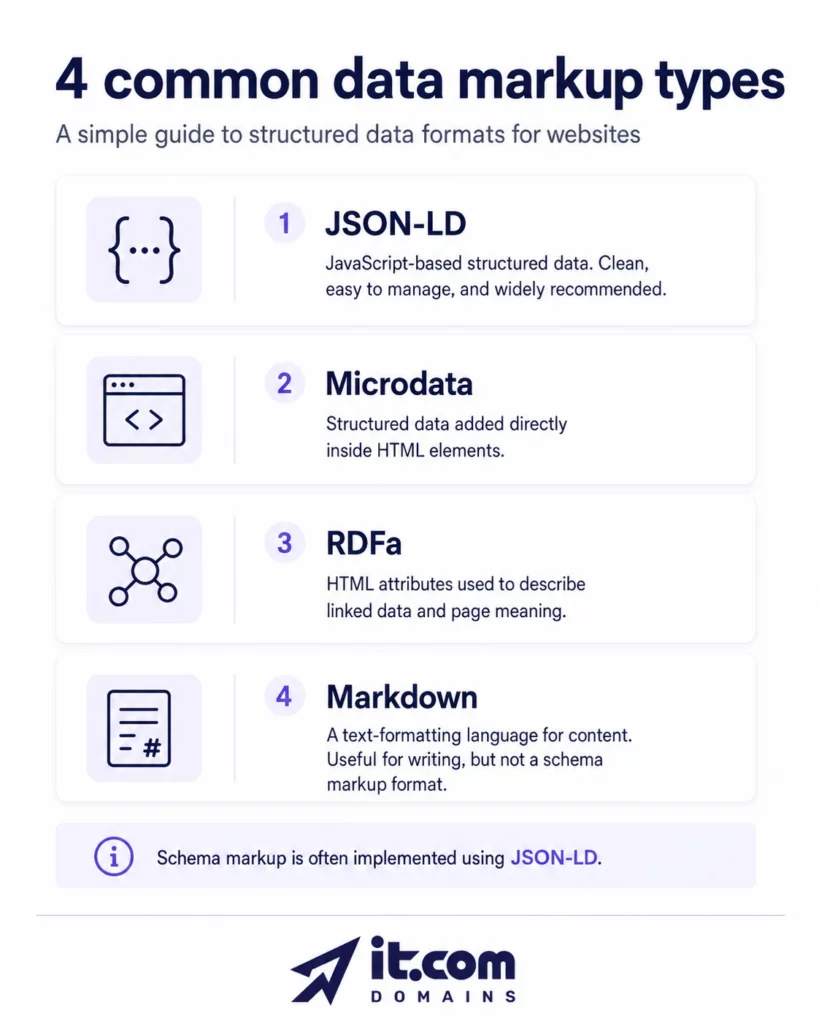
Structured data can be added in several formats.
JSON-LD is the format Google generally recommends when a site setup allows it. It sits inside a script tag and keeps structured data separate from the visible page content.
For many business owners, JSON-LD is the cleanest option because it is easier to manage, update and less likely to interfere with page design.
Microdata adds labels directly inside the HTML on the page. It can work well, but it may become harder to manage as a website grows.
RDFa is another markup format that adds structured data through HTML attributes. It is powerful, but often more technical than most small business websites need.
Markdown is different. It is a lightweight formatting language used to create readable text, headings, links, and lists. It is useful for writing content, but it is not the same as schema markup.
A blog draft may be written in Markdown. Structured data markup, often in JSON-LD, tells machines what that content means.
A structured data setup often follows a simple process. The exact steps depend on the website platform, content management system, and available developer support.
Many websites start with pages that have clear business value. These may include the homepage, product pages, service pages, location pages, blog articles, and FAQs.
A small ecommerce site such as skincarestore.it.com might focus first on product pages and FAQ pages. A local plumber might begin with the homepage, service pages, and location page.
A variation of the approach for larger sites might be classifying all pages into types and mapping schema to each page type - for example, product pages, or blog articles.
Each page needs a schema type that fits its purpose. Product pages may use Product schema. Blog posts may use Article schema. A physical store may use LocalBusiness schema.
The Schema.org official website can help identify available types and properties. Google’s structured data documentation can also show which types may be eligible for Google Search features.
The markup should match the visible content on the page. If the page shows a price, rating, author, or opening hours, the structured data can label that same information.
This is where accuracy matters. If the markup says a product is in stock but the page says it is sold out, machines may read conflicting signals.
Some website platforms and SEO plugins create schema markup automatically. Other websites may use a generator or the structured data markup helper to create basic markup.
For a more hands-on setup, a business or developer can write JSON-LD manually.
An AI prompt can also help draft the first version:
Prompt example:
“Create JSON-LD Product schema for a product page on my website. The product is [product name], the brand is [brand], the price is [price], availability is [in stock/out of stock], and the product page URL is . Use Schema.org vocabulary and inc...how-to-create-one-for-your-website/']sitemaps explains how they work and how they support website visibility.

Source: Unsplash
Structured data works best when it reflects real page content. The markup should not include hidden claims, fake reviews, unavailable products, or information that users cannot see.
For small business websites, a clean starting point may include:
It also helps to keep names consistent. If a business uses “Bright Legal IT” on its website, social profiles, directories, and schema markup, machines get a clearer entity signal than if the name appears in five different ways.
A domain name can support that clarity too. A name like brightlegal.it.com or denverdentist.it.com gives both users and machines a quick clue about the business or category. The domain is not a replacement for good content or technical SEO, but it can be part of a cleaner digital identity.
Structured data markup helps search engines and AI systems understand the meaning behind website content. It labels important details, such as products, prices, reviews, locations, authors, and FAQs, in a format machines can read.
For small and medium businesses, schema markup can support search visibility, rich result eligibility, and clearer AI interpretation. The setup process is manageable when it starts with the most important pages, uses the right schema types, and includes regular testing.
Structured data markup is code added to a webpage to explain what the content means. It can label details such as products, prices, reviews, business hours, events, and FAQs in a machine-readable format.
Structured data is not one single markup language. It is organized information that can be written in different formats, including JSON-LD, Microdata, and RDFa. Schema markup is a common way to create structured data using Schema.org vocabulary.
Structured data is labeled information that helps machines understand a page. For example, a product page on shoes.it.com might use Product schema to label the product name, image, price, availability, rating, and brand.
Structured data is the organized information added to a page. Schema markup is one method of creating that structured data using the shared vocabulary from Schema.org. In everyday SEO conversations, people often use the two terms together.
A common process is to choose the key pages, select the right schema type, collect visible page details, generate JSON-LD markup, add it to the page, and test it with validation tools. Many CMS platforms and SEO plugins can also automate parts of the setup.
Structured data markup can support SEO by helping search engines understand a page and by making some pages eligible for rich results. It is not a ranking guarantee, but it can improve clarity, presentation, and machine readability.
Markdown and JSON serve different jobs. Markdown is useful for formatting readable content, such as headings, lists, and links. JSON, especially JSON-LD, is better suited for structured data because it organizes information in a format machines can parse.
JSON is a data format used to store and exchange information. Schema is a vocabulary or structure that defines what the information means. JSON-LD can use Schema.org.
Need some tips to get your website discovered online? Visit it.com Domains blog and follow us on social media.
Continue reading at the it.com Domains blog...
Let’s explore what structured data is, how data markup works, and why schema markup matters for business websites. We’ll also cover common markup types, the difference between JSON and Markdown, and a simple step-by-step process for setting up structured data on a website.
What Is Structured Data?
Structured data is information added to a webpage in a standardized format so machines can understand the content more clearly. In simple terms, it labels the important parts of a page.
For example, a human can look at a product page and understand the product name, price, reviews, availability, and delivery details. A search engine crawler or AI bot needs a markup next to those details presented in a clearer, machine-readable way to indicate that the information is indeed price, name or delivery.
Structured data markup can tell systems:
- This page is about a product.
- This number is the price.
- This piece of text is a customer rating.
- This date is an event time or article publishing date.
- This section is an FAQ.
Google describes structured data as a standardized format for providing information about a page and classifying its content. The company also shares examples where structured data helped websites improve rich result performance. Rotten Tomatoes measured a 25% higher click-through rate on pages enhanced with structured data, while Food Network saw a 35% increase in visits after converting many pages to support search features.
It does not mean every website will see the same outcome. Structured data does not guarantee traffic. It does, however, make a website easier for search engines to interpret.
Source: Pexels
Structured Data, Schema Markup, and Data Markup Explained
These terms often appear together, so it helps to separate them.
Structured data is the organized information added to a page.
Data markup is the code used to label that information.
Schema markup is a specific type of structured data markup based on the vocabulary from the Schema.org official website.
Think of it like labeling boxes in a storage room. Without labels, a person may still work out what is inside. With labels, everything becomes faster and clearer. Structured data gives search engines and AI platforms those labels.
For a local business website such as freshflowers.it.com, schema markup could identify:
- The business name
- Location
- Opening hours
- Product categories
- Customer reviews
- Delivery areas
- Frequently asked questions
This can help search engines understand that the website belongs to a florist, serves certain locations, sells specific products, and answers customer questions.
Why Structured Data Matters for SEO and LLMs
Structured data has long been part of technical SEO (search engine optimization. It can help websites to be surfaced in rich results, such as product details, ratings, FAQs, events, and recipe information.
It also has a growing role in AI discovery. Large language models and AI search systems need to extract facts from websites quickly and rely on retrieval by AI bots. Clear structured data can make that task less messy. This relates closely to generative engine optimization, where businesses aim to make their content easier for AI platforms to understand, summarize, and cite.
The same principle applies to optimizing for agentic commerce. If AI agents compare products, check availability, or shortlist services for users, clean structured data can help them understand what a business offers. AI agents rely on schema markup to interpret entities, relationships, relevance, and trust signals: the clearer the data, the easier it is for machines to understand the business.
Source: Pexels
Common Types of Structured Data Markup
Different websites need different markup types. A local service business, online store, blog, and event website will not always use the same schema.
Organization and local business markup
Organization schema can describe a company’s name, logo, website, social profiles, and contact details. LocalBusiness schema adds location-based details such as address, opening hours, phone number, and service area.
A business using a domain like petcare.it.com could use LocalBusiness markup to clarify where it operates, what services it offers, and how customers can contact the team.
Product markup
Product schema is useful for ecommerce websites. It can describe product names, images, prices, availability, ratings, and reviews.
For example, an online store at runninggear.it.com could use Product markup for shoes, water bottles, or fitness accessories. This data may help search engines understand product details without relying only on visible page design.
FAQ markup
FAQ schema labels questions and answers on a page. It works best when the page includes genuine, visible FAQs that answer common customer questions.
For a software company at invoices.it.com, FAQ markup could label answers about pricing, free trials, setup, and integrations.
Article and blog markup
Article schema can help identify the headline, author, publication date, image, and publisher. This is useful for businesses that publish guides, news, and thought leadership content.
It also supports wider content clarity, especially when paired with strong internal linking, clear authorship, and regularly updated pages.
JSON-LD, Microdata, RDFa, and Markdown: What Is the Difference?
Structured data can be added in several formats.
JSON-LD
JSON-LD is the format Google generally recommends when a site setup allows it. It sits inside a script tag and keeps structured data separate from the visible page content.
For many business owners, JSON-LD is the cleanest option because it is easier to manage, update and less likely to interfere with page design.
Microdata
Microdata adds labels directly inside the HTML on the page. It can work well, but it may become harder to manage as a website grows.
RDFa
RDFa is another markup format that adds structured data through HTML attributes. It is powerful, but often more technical than most small business websites need.
Markdown
Markdown is different. It is a lightweight formatting language used to create readable text, headings, links, and lists. It is useful for writing content, but it is not the same as schema markup.
A blog draft may be written in Markdown. Structured data markup, often in JSON-LD, tells machines what that content means.

Step-by-step: How Structured Data Markup Is Set Up
A structured data setup often follows a simple process. The exact steps depend on the website platform, content management system, and available developer support.
Step 1: Choose the most important pages
Many websites start with pages that have clear business value. These may include the homepage, product pages, service pages, location pages, blog articles, and FAQs.
A small ecommerce site such as skincarestore.it.com might focus first on product pages and FAQ pages. A local plumber might begin with the homepage, service pages, and location page.
A variation of the approach for larger sites might be classifying all pages into types and mapping schema to each page type - for example, product pages, or blog articles.
Step 2: Match each page to the right schema type
Each page needs a schema type that fits its purpose. Product pages may use Product schema. Blog posts may use Article schema. A physical store may use LocalBusiness schema.
The Schema.org official website can help identify available types and properties. Google’s structured data documentation can also show which types may be eligible for Google Search features.
Step 3: Collect the page details
The markup should match the visible content on the page. If the page shows a price, rating, author, or opening hours, the structured data can label that same information.
This is where accuracy matters. If the markup says a product is in stock but the page says it is sold out, machines may read conflicting signals.
Step 4: Generate the markup
Some website platforms and SEO plugins create schema markup automatically. Other websites may use a generator or the structured data markup helper to create basic markup.
For a more hands-on setup, a business or developer can write JSON-LD manually.
An AI prompt can also help draft the first version:
Prompt example:
“Create JSON-LD Product schema for a product page on my website. The product is [product name], the brand is [brand], the price is [price], availability is [in stock/out of stock], and the product page URL is . Use Schema.org vocabulary and inc...how-to-create-one-for-your-website/']sitemaps explains how they work and how they support website visibility.
Source: Unsplash
Practical Tips for Better Structured Data Markup
Structured data works best when it reflects real page content. The markup should not include hidden claims, fake reviews, unavailable products, or information that users cannot see.
For small business websites, a clean starting point may include:
- Organization schema on the homepage
- LocalBusiness schema for physical locations
- Product schema for ecommerce pages
- Article schema for blog posts
- FAQ schema for genuine question-and-answer sections
- Breadcrumb schema to clarify site structure
It also helps to keep names consistent. If a business uses “Bright Legal IT” on its website, social profiles, directories, and schema markup, machines get a clearer entity signal than if the name appears in five different ways.
A domain name can support that clarity too. A name like brightlegal.it.com or denverdentist.it.com gives both users and machines a quick clue about the business or category. The domain is not a replacement for good content or technical SEO, but it can be part of a cleaner digital identity.
Structured data markup helps search engines and AI systems understand the meaning behind website content. It labels important details, such as products, prices, reviews, locations, authors, and FAQs, in a format machines can read.
For small and medium businesses, schema markup can support search visibility, rich result eligibility, and clearer AI interpretation. The setup process is manageable when it starts with the most important pages, uses the right schema types, and includes regular testing.
FAQs
What is a structured data markup?
Structured data markup is code added to a webpage to explain what the content means. It can label details such as products, prices, reviews, business hours, events, and FAQs in a machine-readable format.
Is structured data a markup language?
Structured data is not one single markup language. It is organized information that can be written in different formats, including JSON-LD, Microdata, and RDFa. Schema markup is a common way to create structured data using Schema.org vocabulary.
What is structured data with an example?
Structured data is labeled information that helps machines understand a page. For example, a product page on shoes.it.com might use Product schema to label the product name, image, price, availability, rating, and brand.
What is the difference between structured data and schema markup?
Structured data is the organized information added to a page. Schema markup is one method of creating that structured data using the shared vocabulary from Schema.org. In everyday SEO conversations, people often use the two terms together.
How to do structured data markup?
A common process is to choose the key pages, select the right schema type, collect visible page details, generate JSON-LD markup, add it to the page, and test it with validation tools. Many CMS platforms and SEO plugins can also automate parts of the setup.
Is structured data markup good for SEO?
Structured data markup can support SEO by helping search engines understand a page and by making some pages eligible for rich results. It is not a ranking guarantee, but it can improve clarity, presentation, and machine readability.
Is Markdown better than JSON?
Markdown and JSON serve different jobs. Markdown is useful for formatting readable content, such as headings, lists, and links. JSON, especially JSON-LD, is better suited for structured data because it organizes information in a format machines can parse.
What is the difference between JSON and schema?
JSON is a data format used to store and exchange information. Schema is a vocabulary or structure that defines what the information means. JSON-LD can use Schema.org.
Need some tips to get your website discovered online? Visit it.com Domains blog and follow us on social media.
Continue reading at the it.com Domains blog...



